







Modeling
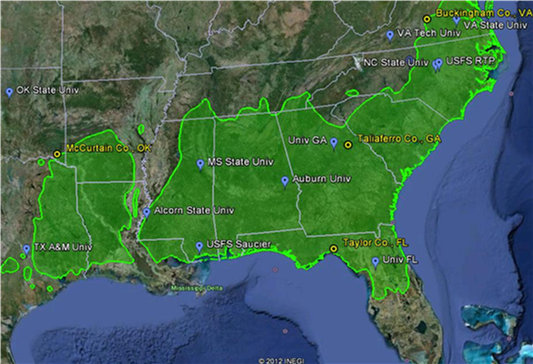
The modeling team is applying a multi-scaled modeling program incorporating monitoring data from the PINEMAP three-tiered, regionwide monitoring network with spatially-explicit historical and predicted future climate data to assess alternative forest management approaches and the impacts on carbon sequestration and resilience to disturbance.
The existing inventory from the extensive PINEMAP Tier I network, as well as existing inventory and new carbon and nutrient dynamics data from PINEMAP Tier II and III networks and experimental manipulations, are being used to parameterize and validate a coordinated series of open-source models ranging in complexity and scale from tree- to regional-level. These models will be used to design and test novel forest management systems focused on greenhouse gas mitigation, enhanced resource use efficiency, and resilience to climate change.
The models developed will be used to analyze a range of management, climate, and disturbance scenarios. Effective mitigation and adaptation to climate change in forests requires a large-scale approach that explicitly considers trade-offs between different goals. The modeling team will evaluate climate change mitigation and adaptation trade-offs so that optimal management strategies can be developed at the landscape to regional level.
PINEMAP is utilizing four primary models:
- Growth and Yield models (Forest Modeling Research Cooperative; Plantation Management Research Cooperative)
- 3-PG (Physiological Principles in Predicting Growth; Landsberg & Waring, 1997)
- NASA CASA (Carnegie Ames Stanford Approach; Potter et al., 1999)
- WaSSI (Water Supply Stress Index Model; Sun et al., 2008)