







Research Summaries
- Silviculture & Ecophysiology
- Early Impacts of Rainfall Manipulation and Fertilization Treatments on the Ecophysiology of Loblolly Pine in the Georgia Tier III Installation PDF document
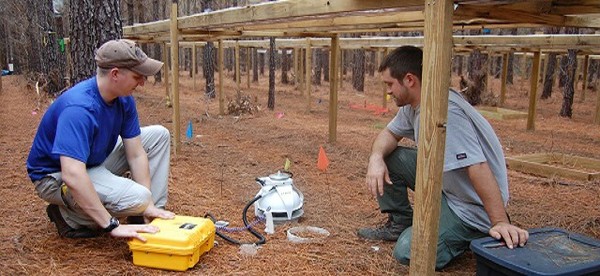
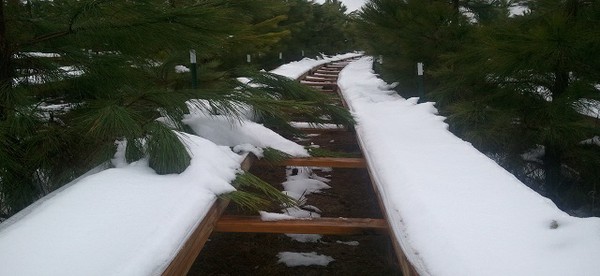
- PINEMAP Research Summary, February 2013. Authors: Joe Clark, Lisa Samuelson, and Stan Bartkowiak. A central goal of the PINEMAP project is to quantify climate, soils, and management impacts on carbon sequestration in planted pine ecosystems and provide data on these impacts to build and verify models that simulate pine forest dynamics under varying climate. To help achieve this goal, we are studying the interactive effects of a 30% reduction in rainfall and nutrient availability on the ecophysiology of loblolly pine. This field experiment is part of the PINEMAP Tier III “Throughfall Exclusion x Fertilization” network, in which nutrients and water are manipulated at four sites situated at the edges of the native loblolly pine range.
- Modeling
- The Canopy Underground: Convergence of the Effect of Root Hydraulic Functioning and Root Hydraulic Redistribution on Ecosystem Carbon Balance Across Divergent Loblolly Pine Forests PDF document
- PINEMAP Research Summary, November 2012. Authors: Jean-Christophe Domec, Jérôme Ogée, Asko Noormets, Julien Jouangy, Michael Gavazzi, Emrys Treasure, Ge Sun, Steve McNulty, and John S. King. Deep root water uptake and hydraulic redistribution (HR) have been shown to play a major role in forest ecosystems during drought, but little is known about the impact of climate change, fertilization, and soil characteristics on HR and its consequences on water and carbon fluxes. Using data from three mid-rotation loblolly pine plantations and simulations with the process-based model MuSICA, this study indicated that HR can mitigate the effects of soil drying and had important implications for carbon uptake potential and net ecosystem exchange (NEE), especially when N fertilization is considered.
- Genetics
- Comparing Genotyping Technologies for Efficiency and Cost-effectiveness PDF document
- PINEMAP Research Summary, October 2012, Authors: Ross Whetten, Konstantin Krutovsky, and Jason Holliday. Several methods for genotyping using high-throughput DNA sequencing have been described using model organisms or annual crops. Application of these techniques to conifers, such as loblolly pine, is not trivial, because the pine genome is several times larger and contains more repetitive DNA than most of the species in which these techniques were developed. As part of the PINEMAP research objectives on genetic analysis of pine populations, we have compared several techniques to evaluate the relative strengths, weaknesses, costs, and benefits of each. No single technique is optimal for every purpose, so the objectives of individual experiments are important in determining which method is best suited to achieve the desired results.
- Economics & Policy
- Predicting Species Richness in Forest Inventories: Implications for Assessing Ecosystem Service Trade-offs PDF document
- PINEMAP Research Summary, November 2012. Authors: Nilesh Timilsina, Wendell Cropper, Jr., Francisco Escobedo, and Joanna Tucker. We developed a model to predict herbaceous richness using stand level and management data in Forest Inventory. Our model explained 57% of the variation in herbaceous richness in coastal plain flatwoods of the southeastern USA. Results were verified using field data and stand age, forest type, time since fire, and time since herbicide-fertilizer application were important predictors of herbaceous species richness.
- Determining the Impact of Hurricane Risk on Optimal Forest Management in Southern Pine Plantations PDF document
- PINEMAP Research Summary, February 2013. Authors: Andres Susaeta, Douglas Carter, Sun Joseph Chang, and Damian Adams. Catastrophic natural events have a significant influence on forest management decisions, and climate change has the potential to increase risks related to hurricanes and other extreme weather events. In the southern U.S., hurricanes pose a major economic threat; from 1949-2006, total economic property losses due to hurricanes amounted to $127 billion, representing 85% of the nation’s total losses due to hurricanes.
- Education
- Cultural Cognition and Educator Engagement in Climate Change PDF document
- PINEMAP Research Summary, June 2015. Authors: Kristen Kunkle and Martha Monroe. The results of an online survey distributed among science educators in five states suggest that worldview values and personal beliefs about climate change have a significant influence on respondents' intentions to support climate change education and preferred curriculum content. Despite their disagreements over the value and relevant content of climate change education, respondents of diverse perspectives agreed that climate change education can provide valuable opportunities to engage students in current issues. However, formal educators perceive limited ability to provide these opportunities given the time and curriculum constraints of the public education system.
- Measuring the Effectiveness of Educational Materials on Climate Change and Forests PDF document
- PINEMAP Research Summary, December 11, 2014. Authors: Christine Li and Martha Monroe. A formative evaluation of a new resource for secondary teachers, Southeastern Forests and Climate Change, was conducted in fall 2013. A total of 44 secondary science teachers used two to four activities and submitted feedback on their experiences. They believed the materials were appropriate for high school students and met the objectives. Using teacher feedback, the materials were revised to reduce confusion, additional explanations were added to help middle school teachers adapt the activities, systems thinking exercises and connections were added, and a new introductory activity was developed.
- Understanding Southeastern Science Teachers' Interest in Climate Change Education PDF document
- PINEMAP Research Summary, July 2012, Authors: M.C. Monroe, A. Oxarart, and R. Plate. A survey of secondary science teachers in southeastern United States (n=746) suggests that a unit on climate change in life science and environmental science classes should connect science to students' lives with critical thinking and data analysis skills. Controversy over climate change can be addressed by presenting the data associated with various perspectives and discussing the nature of science.
- Addressing Climate Change through Biology Concepts PDF document
- PINEMAP Research Summary June 2013. Authors: S. Hall and M. Monroe. An experimental test of a high school science activity suggests that connecting the biology concepts of the carbon cycle and carbon sequestration to climate change increases student interest and knowledge gain about those biological concepts. Students’ perception of parents’ attitude about climate change was significantly correlated with student attitude about climate change for two out of three groups.
- Extension
- The Six Americas of Climate Change: Perceptions of Southeast Extension Professionals PDF document
- PINEMAP Research Summary, July 2012. Authors: D.C. Adams, M.C. Monroe, R. Plate, and D. Wojcik. This study measured Extension professionals’ perceptions of global climate change. With the participation of eight states and using methods from several national studies, survey responses from 2,589 Extension professionals in the Southeast placed them in one of six categories ranging from alarmed through dismissive. Results show a pattern similar to earlier national studies with the general public; all six categories are represented. Distribution across these categories varies by state, political leaning, education level, and program area. The importance of in-service training, applicable information, and administrative support for programming on climate change mitigation and adaption are discussed.
- Climate Change Perceptions of Southern Foresters: Preliminary Survey Results PDF document
- PINEMAP Research Summary, May 2013. Authors: L. Boby, W. Hubbard, and H. Cole. Southern foresters were surveyed to gain a better understanding of their experiences, perceptions, beliefs, attitudes and interests in continuing education topics and formats regarding climate science and climate change. The survey provides insight into several inferential questions regarding a forester’s world-view and their associated receptivity to making forest management changes to increase resiliency. Information from this survey will be used to develop educational programs and tools that meet foresters’ interests and needs while accommodating different perceptions. This survey was conducted in collaboration with the Pine Integrated Network: Education, Mitigation and Adaptation Project (PINEMAP). PINEMAP is a USDA project that combines forestry research, education and extension teams to create and disseminate the knowledge to increase pine plantation resiliency in the Southern United States.
- 2013 Climate Change Attitudes of Southeast Forestry Professionals: Implications for Outreach PDF document
- PINEMAP Research Summary, April 2014. Authors: H. Morris, M. Megalos, W. Hubbard, and L. Boby. We surveyed Southeast forestry professionals to better understand their climate change perceptions and attitudes. We found that demographic variables—specifically political ideology, age, education level, employer, gender, and years of forestry experience—significantly influence foresters’ climate change attitudes. Our results also show that foresters’ climate change attitudes, personal perceptions of climate change, and management responses are closely related. We conclude that Extension can motivate adaptive management by helping foresters connect to climate change, illustrating how climate change will impact forestry and demonstrating suitable silvicultural management responses.
- Communicating Climate Change with Forest Landowners through Video PDF document
- PINEMAP Research Summary, April 2014. Authors: Shelby Krantz and Martha Monroe. This study explored the effect of framing messages in a video on landowners’ attitudes toward and intentions to adopt forest management strategies to increase their forests’ resilience to possible climate changes. When the video reinforced a viewer’s values, demonstrated actions to promote feelings of efficacy, and used likeable speakers to generate feelings of homophily, the viewer’s intention to act was enhanced.
- North Carolina Cooperative Extension Professionals' Climate Change Perceptions, Willingness, and Perceived Barriers to Programming PDF document
- PINEMAP Research Summary, October 2014. Authors: R.E. Burnett, A. Vuola, M.A. Megalos, M.C. Monroe and D.C. Adams. This study evaluated North Carolina Cooperative Extension Professionals' perceptions of global warming, willingness to participate in climate change-related programs, and barriers to climate change programming. Survey results show that the majority of NCCE professionals are cautious, concerned, or alarmed about global warming and are willing to engage in climate change programming. They perceive lack of audience interest, conflicting information, and lack of applied information to be the greatest barriers to programming.
- Survey Questions: Climate Change Attitudes of Southern Foresters PDF document
- In early 2013, we surveyed nearly 2,000 southern foresters about their perceptions of climate change, observations and concerns about climatic and forest conditions, and knowledge of and interest in resilient forest management techniques and climate science. This link provides the survey questions that we used.
Eigenbrode, S.D., L.W. Morton, and T.A. Martin. 2014. Big interdisciplinarity to address climate change and agriculture: Lessons from three USDA Coordinated Agricultural Projects. Journal of Soil and Water Conservation 69(6): 170A-175A. http://dx.doi.org/10.2489.jswc.69.6.170A