








Aim Summaries
Pinemap Aims
Aim 1 - Silviculture/Ecophysiology
Goal: Establish a regionwide three-tiered monitoring network based on existing cooperative research trials, and develop standardized methods to quantify C, water, and nutrient storage and flux baselines and responses to climate change.
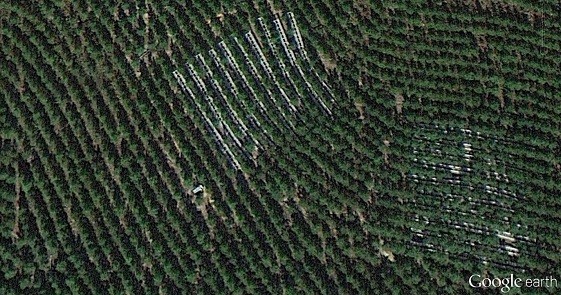
PINEMAP Aim 1 encompasses silviculture and ecophysiology research through a network of three tiers of research sites in the southern United States. Tier I sites provide regional spatial and temporal variability data on forest productivity relative to geographic and climatic factors. Research sites in Tier II are chosen to optimize variation across a number of site characteristics. Tier II research includes data collection on carbon pools and fluxes both above- and below-ground, soil heterotrophic respiration. These sites are used to collect other trait metrics in conjunction with genetic diversity information to identify genes and alleles controlling productivity and adaptivity traits. Such traits are important for ecosystem function, sustainability and tree breeding in the context of climate change. Tier III sites use loblolly pine (Pinus taeda) to determine the effects of interactions among fertilization, precipitation and genetic variables. Researchers will conduct vegetation and soil sampling at Tier II and III sites. These samples will determine amounts of carbon, nitrogen use efficiency, and how these variables differ by soil and climate across the South. These data will be used to create guidelines for alternative fertilization methods that improve nitrogen use efficiency.
Aim 2 - Modeling
Goal: Apply a multi-scaled modeling program incorporating data from the monitoring network, empirical growth and yield models, stand-level biophysical C balance models, and watershed to regional scale C and water models driven by remote sensing to assess alternative forest management systems for sustainably increasing mitigation of greenhouse gases while adapting to changing climate and associated disturbances.
Modeling the complex interactions between climate, soils, genetics, and forest management is essential to providing appropriate guidance to forest managers. This aim will design and test new genetic and forest management systems that focus on greenhouse gas mitigation, resource use efficiency, and resilience to climate change. Researchers will develop parameters for current open-source models using data from Aim 1 Tier I through Tier III networks and research. The result is a set of parameterized timber growth, timber yield, and carbon balance models that researchers can use at physiographic, watershed and stand scales. Then, researchers will analyze interactions of forest management, climate change, and disturbance scenarios to create optimal management strategies for landscape to regional level forest management operations. Additionally, the Extension Aim will use these models in the creation of decision support systems for forest managers and landowners.
Aim 3 - Genetics
Goal: Analyze genetics of breeding and natural populations to discover alleles in genes controlling important adaptation and mitigation traits that enable future tree breeding strategies, and deliver deployment guidelines for genotypes suited for varied climatic conditions to maximize resiliency and reduce adverse impacts of climate change on productivity.
The genetics team will integrate available growth, survival, genetic and environmental data from trials to create parameters for response functions. These functions, along with predictions of future climate, will enter into a model to estimate relative productivity and adaptation of genetic material to specific climatic conditions. In addition, three complimentary populations of loblolly pines will be part of a study examining the genetic basis of traits linked to productivity and adaptation. The genetics Aim will measure productivity traits, which include response to nitrogen fertilization, and adaptive traits such as cold hardiness, wood density, lignin content and oleoresin flow. The last of these traits is important as it is a measure of resistance to the southern pine beetle. Genome sequencing will be carried out to relate variation in these traits to molecular genetic variation. Researchers are particularly interested in how genetics shapes adaptive traits because this knowledge enables the screening of fast growing material for use in breeding programs.
Aim 4 - Economics/Policy
Goal: Conduct comprehensive life cycle analyses of regional forest management systems and multi-scale policy and economic analysis of market and non-market forest benefits and services to evaluate regional tradeoffs and interactions among policy, climate scenarios, carbon/water/nutrient/energy footprints, forest management, and genetic deployment, and assess adoption of alternative approaches by private landowners.
Economic models used for evaluating financial returns of common silvicultural practices currently do not include the impacts of such practices on southern pine forests related to carbon mitigation. Mitigation efforts depend largely on private landowner decisions that are, in turn, affected by government and market incentives. Economic assessments of current and future government programs incentivizing carbon sequestration and climate change mitigation will support PINEMAP and serve as an extension and outreach tool. The economics team will survey industrial and non-industrial private forest landowners and conduct a forest management systems life cycle analysis (LCA). Survey and analysis data will allow researchers to quantify the global warming impacts on economic returns of forest management and to understand landowner choices of and barriers to adapting to climate change. These data can then be used to determine environmental and financial criteria useful for identifying optimal silvicultural strategies. Additionally, economics researchers will build on the life cycle analysis by exploring how carbon sequestration and mitigation efforts could affect ecological functions, goods and services. Researchers will use a regional timber supply model to project changes in forest inventory characteristics based on supply and demand relationships. Also, the team will model climate change impacts on risks of disturbances such as wildfire and southern pine beetle outbreaks and identify the contributions of adaptations to mitigating these risks.
Aim 5 - Education
Goal: Create educational resources and training programs for teachers and extension agents to convey the value and relevance of southern forests and climate change impacts, engage undergraduate interns in research and teaching activities, and contribute to an existing national educational network in the development and delivery of inquiry-based middle and high school lessons that feature our research strategies and tools. Prepare graduate students to address climate change mitigation and adaptation issues.
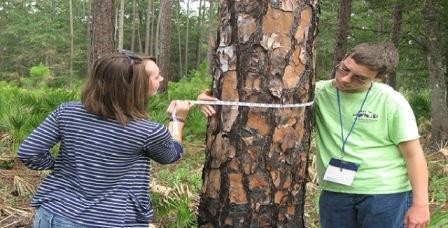
The education Aim of PINEMAP focuses on the creation of educational programs and materials linking research findings to post-secondary students, K-12 educators and students, and Extension faculty. The PINEMAP Intern Program places highly-qualified undergraduate interns with PINEMAP researchers for the summer. During summer internships the undergraduates will gain invaluable experience learning how to conduct research in a chosen discipline. Interns will follow up their summer with a distance education course on speaking to secondary students about climate change and forest resources. Undergraduates participating in the Intern Program will develop educational lessons and activities to present to secondary school students in local communities. These materials will be based on the interns’ summer experiences with field and/or lab research. Another focus of researchers in Aim 5 is to develop a Project Learning Tree secondary module concerning the role of managed southern pine forests in climate change mitigation. The module will also look at how consumers affect the degree of mitigation based on life cycle analyses of consumer products. This module will enable teachers and students to make better decisions about sustainable products. A third facet of Aim 5 is the interdisciplinary education of graduate students and post-graduates. Graduate students will be provided with interactions and training to facilitate greater levels of communication, cooperation, and collaboration among disciplines and research, education and Extension functions.
Aim 6 - Extension
Goal: Develop Extension programming that combines regional climate expertise and forest management outreach to deliver knowledge and state-of-the-art information, resources and management decision support tools to forest landowners, resource managers and policy makers.
The Extension team has the task of demonstrating and distributing knowledge, practices, and tools developed by PINEMAP. Extension personnel will provide this information to influential educators who share it with landowners and resource managers. Because the non-industrial private forestland owner population is larger and more diverse than the industrial forest landowner population, efforts include a focus on underrepresented and underserved landowner populations. Assessing these landowners’ needs will allow the creation of audience-specific materials like fact sheets, videos, and online learning tools. Climatologists and Extension foresters will partner to strengthen interaction and involvement with PINEMAP research teams. They will also be highly involved with education and training programs for stakeholders and target audiences. This team, with the help of the Economics team, will also devise an open-source decision support system for forest managers and landowners. PINEMAP research in silviculture, genetics and economics will be incorporated into this system to create a freely available tool for innovative forest management. Extension researchers will work closely with the economics researchers to develop a variety of assessments. These assessments regard adoption of alternative management systems, engagement of landowners, changes in regional carbon sequestration and nitrogen use efficiency, and understanding of the interaction between climate and forests.
If you have additional questions, please contact the Intern Program Coordinator.